What Happens to the Family Beach House?
Estate Planning for a Second Home.
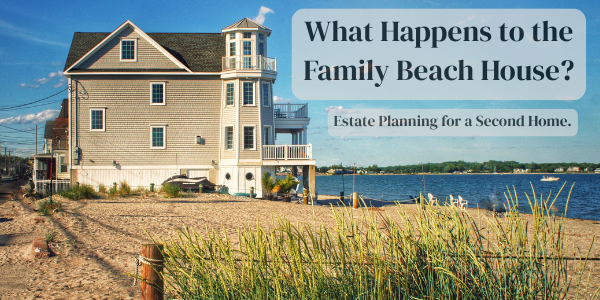
The house is not really about the house.
It is about the summer your kids learned to swim off that dock. It is about the kitchen table that has not been replaced since 1987 because nobody can agree on what should go there instead. It is about the fact that one of your children drives up every weekend and one of them has not visited in four years, and you love them exactly the same.
Second homes are where estate plans go to fall apart. Not because the law is complicated, but because the feelings are.
On the North Shore this comes up constantly. A cottage that has been in the family since the fifties. A place in Essex or Gloucester bought when the numbers still made sense. And a plan that says, in its entirety, that the property goes equally to the children.
Why "equally to the three of them" is not a plan.
Leaving a property to multiple people in equal shares does not give each of them a third of a house. It gives all of them all of the house, together, forever, with no instructions.
That means every decision now requires unanimity. New roof? All three. Rent it out in July? All three. Sell it? All three, and if one says no, the only remedy is a partition action, which is a lawsuit siblings file against each other and rarely recover from.
It also means the sibling who shows up every weekend and the sibling who has not been in a decade have identical votes and identical bills. That imbalance is survivable while you are alive to mediate it. It is much harder afterward.
Who pays for it?
The second question people skip is the expensive one. Taxes, insurance, maintenance, and the roof that is going to need replacing in six years do not stop when you do.
If you leave the house and nothing else, you have handed your children an asset with a running bill attached. For a child whose finances are tight, that is not a gift. That is pressure to sell, applied to the one person least able to absorb it, in front of siblings who will remember how it went.
A plan that works usually sets aside funding alongside the property. A dedicated account, a life insurance policy, or a share of other assets earmarked for carrying costs. It does not have to cover everything forever. It has to cover the transition, so nobody is forced into a decision in year one.
Structures that actually help.
A trust. The property is held in trust with written rules: who can use it and when, how expenses get paid, who makes decisions, and what happens if someone wants out. It also keeps the property out of probate, which matters more when heirs are spread across states.
An LLC. Ownership is divided into membership interests rather than the real estate itself. The operating agreement handles governance and, importantly, transfer restrictions, so a share cannot end up with an in-law after a divorce or a creditor after a bankruptcy.
A buyout provision. Whatever structure you use, build in the exit. A defined way for one owner to be bought out, with a stated valuation method and a payment timeline. Most sibling conflicts over a shared property are not about wanting the house. They are about wanting out and having no way to get there.
*One note specific to Massachusetts.
Massachusetts imposes its own estate tax on estates above $2 million, well below the federal threshold of $15 million. A primary home on the North Shore plus a second property plus retirement accounts crosses $2 million more easily than most families expect.
Massachusetts also does not allow portability of that exemption between spouses the way federal law does. For married couples, that makes the structure of the plan, not just its existence, the thing that determines what the state takes.
The conversation is the hard part.
Everything above is solvable on paper. What is not solvable on paper is the assumption each of your children is currently carrying about what happens to that house, none of which they have said out loud, all of which are different.
The families that get through this well are the ones where the conversation happened while the parents were still in the room. Not a formal meeting. Just a beginning. Here is what we are thinking, here is why, what are we not considering.
The conversation is yours to start. The structure that protects it, the trust, the ownership, the buyout terms, is the part we can handle. If you are ready to have the second conversation, send us a message and let's connect.